/03 · 2024
Asymptotic Grid Shell
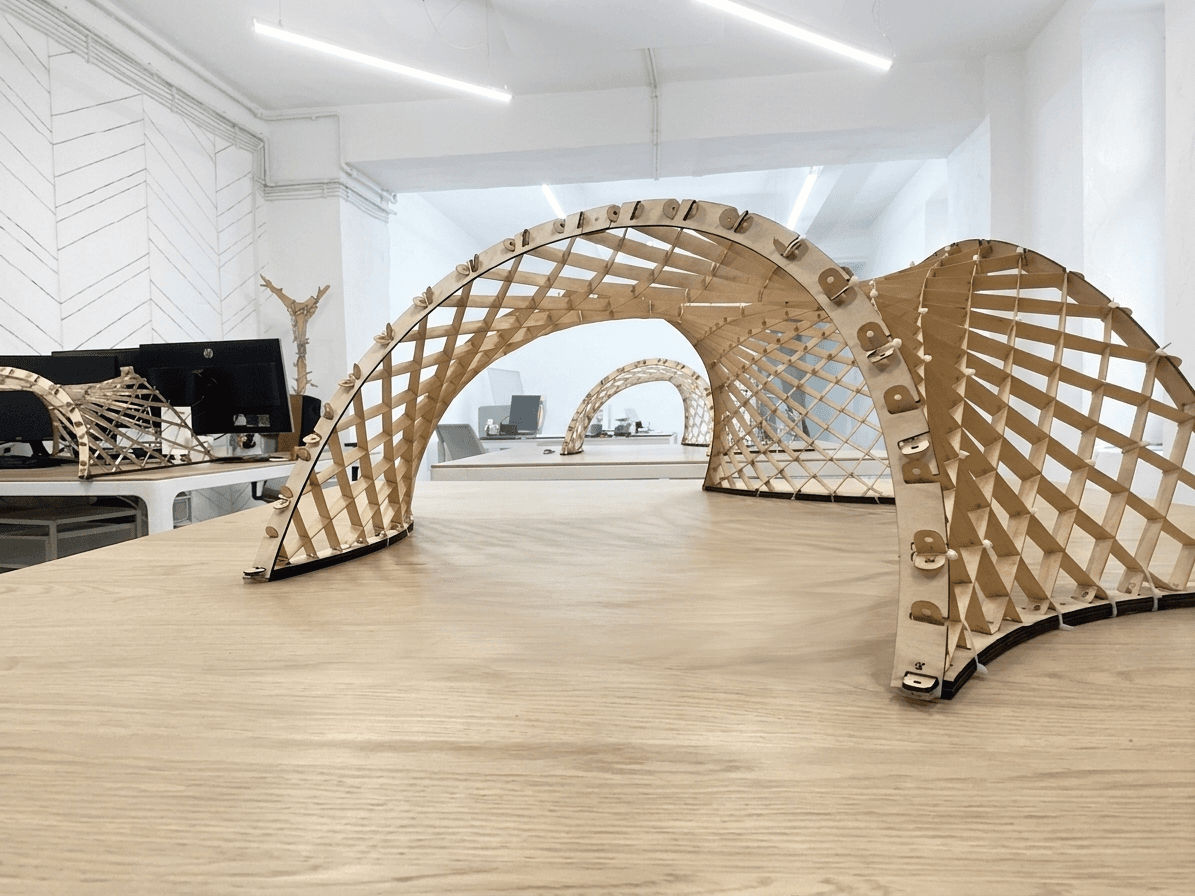
A laser-cut grid-shell built from straight timber strips that bend into a doubly-curved, minimal-surface geometry.
- role
- Group + individual work
- location
- Wrocław · Fab Foundation Poland
- tools
- Rhino · Grasshopper · Kangaroo · Karamba3D · Laser cutter
Overview
The workshop brief was to design an asymptotic grid-shell end-to-end, from curvature theory to a laser-cut model, then scaled up into a full pavilion study. Asymptotic grid-shells are highly efficient structures formed by actively bending flat timber strips along asymptotic curves of an anticlastic surface. Their strict geometric and material constraints make them economical: one node detail, straight unrolled strips, 90° intersections throughout.
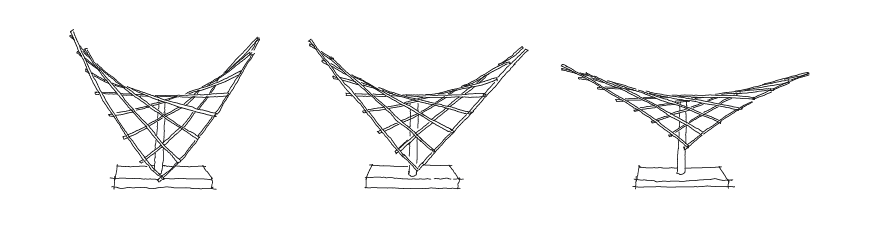
We started with minimal surfaces (Schwarz P, Schwarz D and the Gyroid) and three reference anticlastic surfaces (two Enneper classes and a freeform). At any point of an anticlastic surface there are two asymptotic directions of zero normal curvature; following them generates a curve that only turns sideways, never up or down. Gaussian curvature of the design surface directly drives network density, singularity placement and the geodesic torsion of the asymptotic strips.
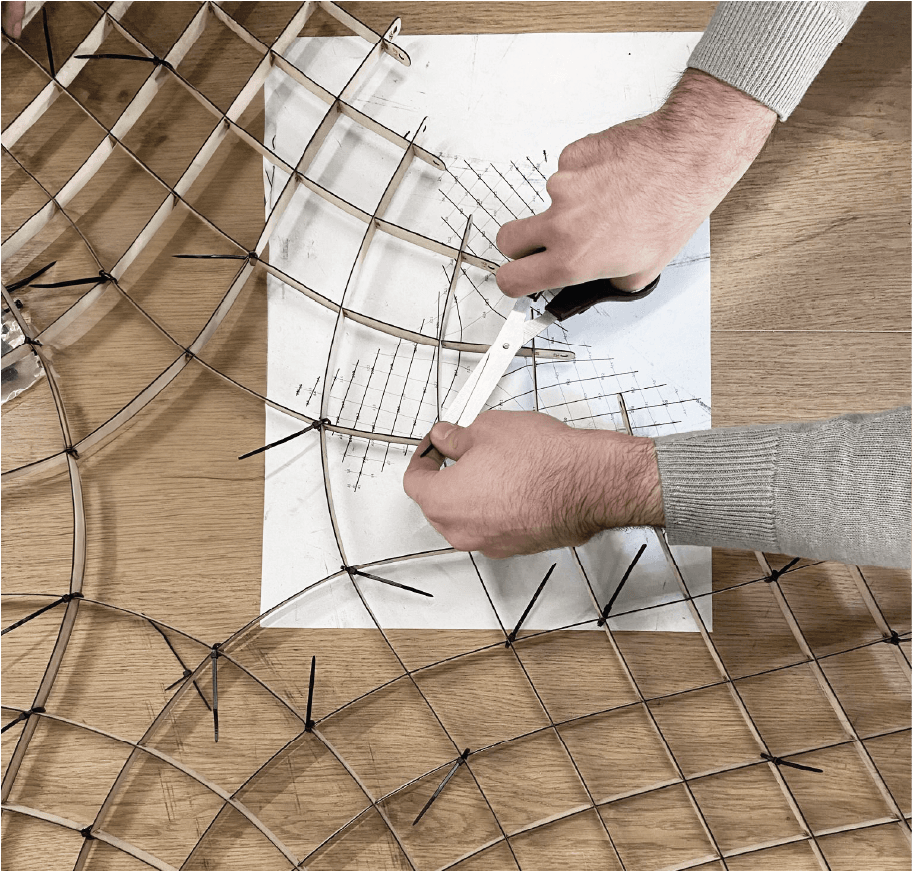
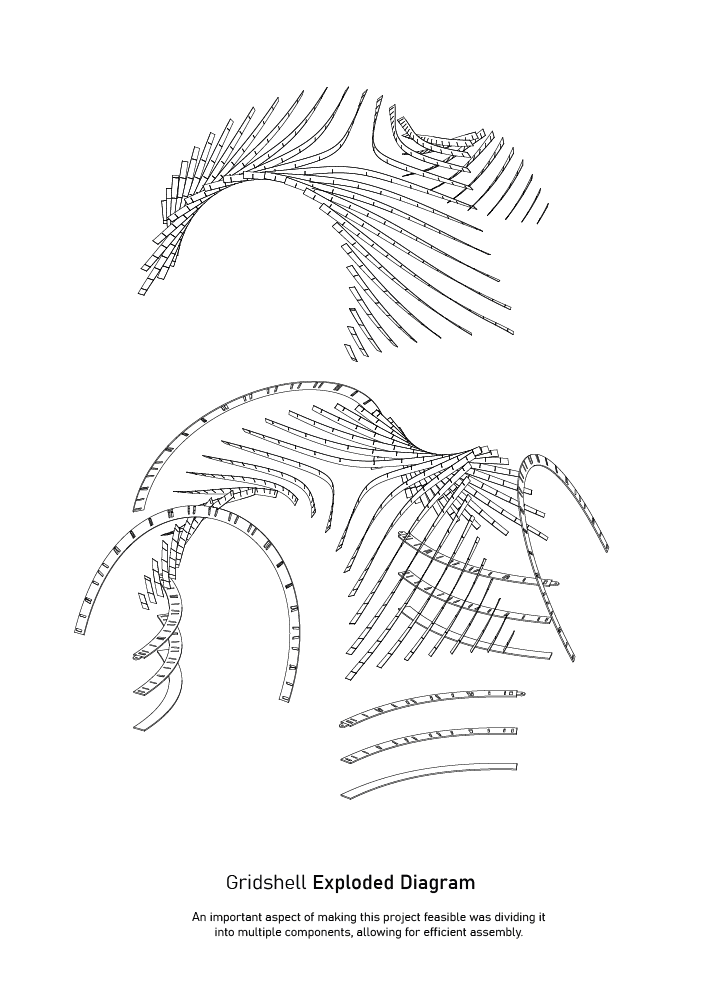
Two parallel lamella layers, connected by regular blocks between them after Frei Otto, added stiffness against buckling while preserving the bending flexibility needed during assembly. Assembly started on a flat plane; adding subsequent strips forced the whole network to adapt into its doubly-curved target geometry. The shell finds its own shape, which is elegant on paper and mildly alarming when you are the one holding the last strip.

Structural optimization · three options
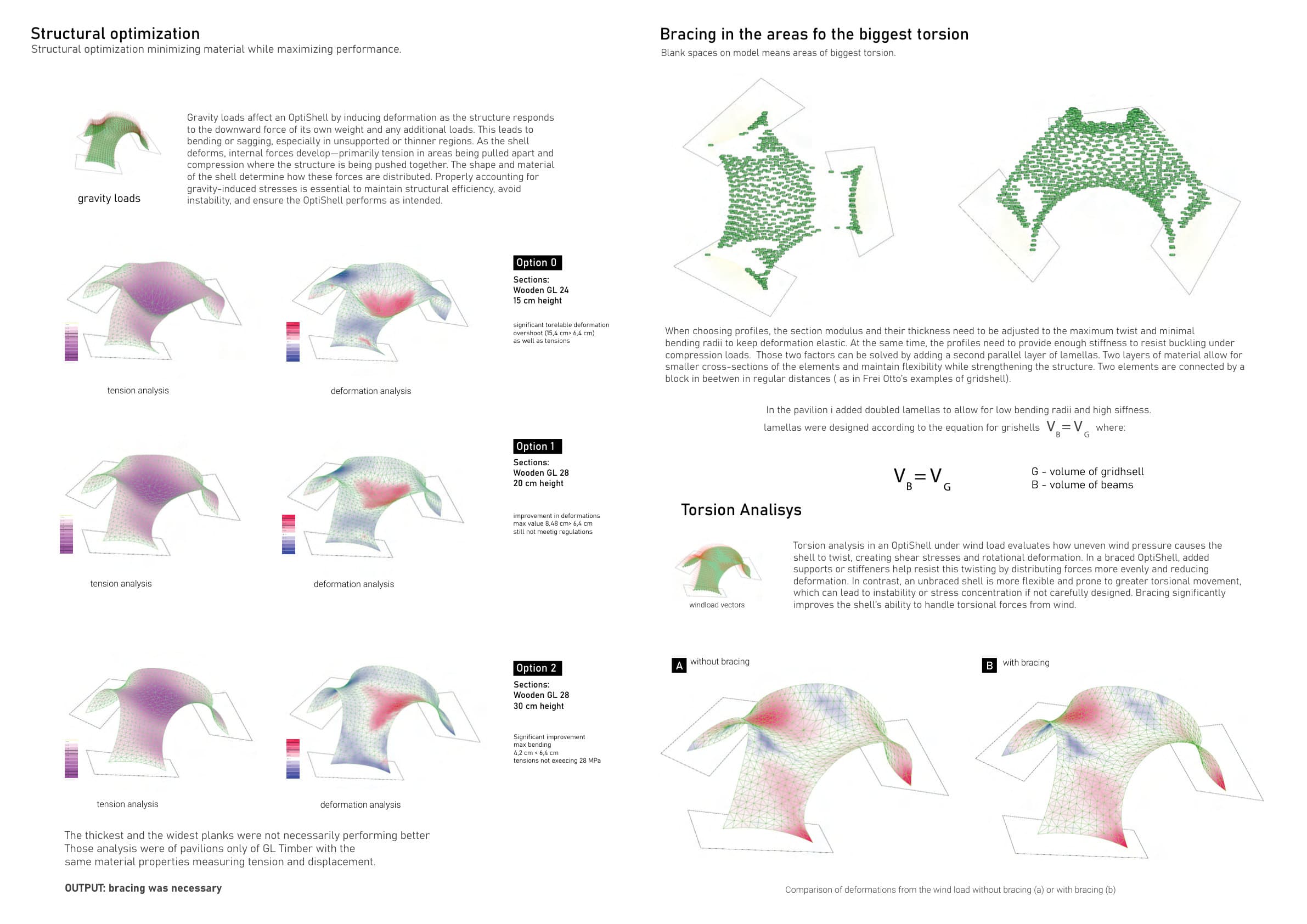
Option 0 used GL 24, 15 cm: significant tolerable overshoot in deformation (15.4 cm vs. a 6.4 cm target). Option 1 upgraded to GL 28, 20 cm: improvement to 8.48 cm max displacement but still outside regulations. Option 2 used GL 28, 30 cm, a significant improvement at 4.2 cm max bending, tensions not exceeding 28 MPa, regulations met. The thickest and widest planks were not necessarily the best; the section modulus had to be tuned to the maximum twist and minimum bending radius.
Torsion analysis · bracing required
Wind load creates uneven pressure that twists the shell, producing shear stresses and rotational deformation. Comparing the unbraced shell (A) with a braced version (B) under the same wind load made the conclusion unavoidable: the unbraced shell was far too flexible against torsion and prone to stress concentrations. Bracing was necessary to distribute the forces and reduce deformation.
Model 39 vs. Model 57
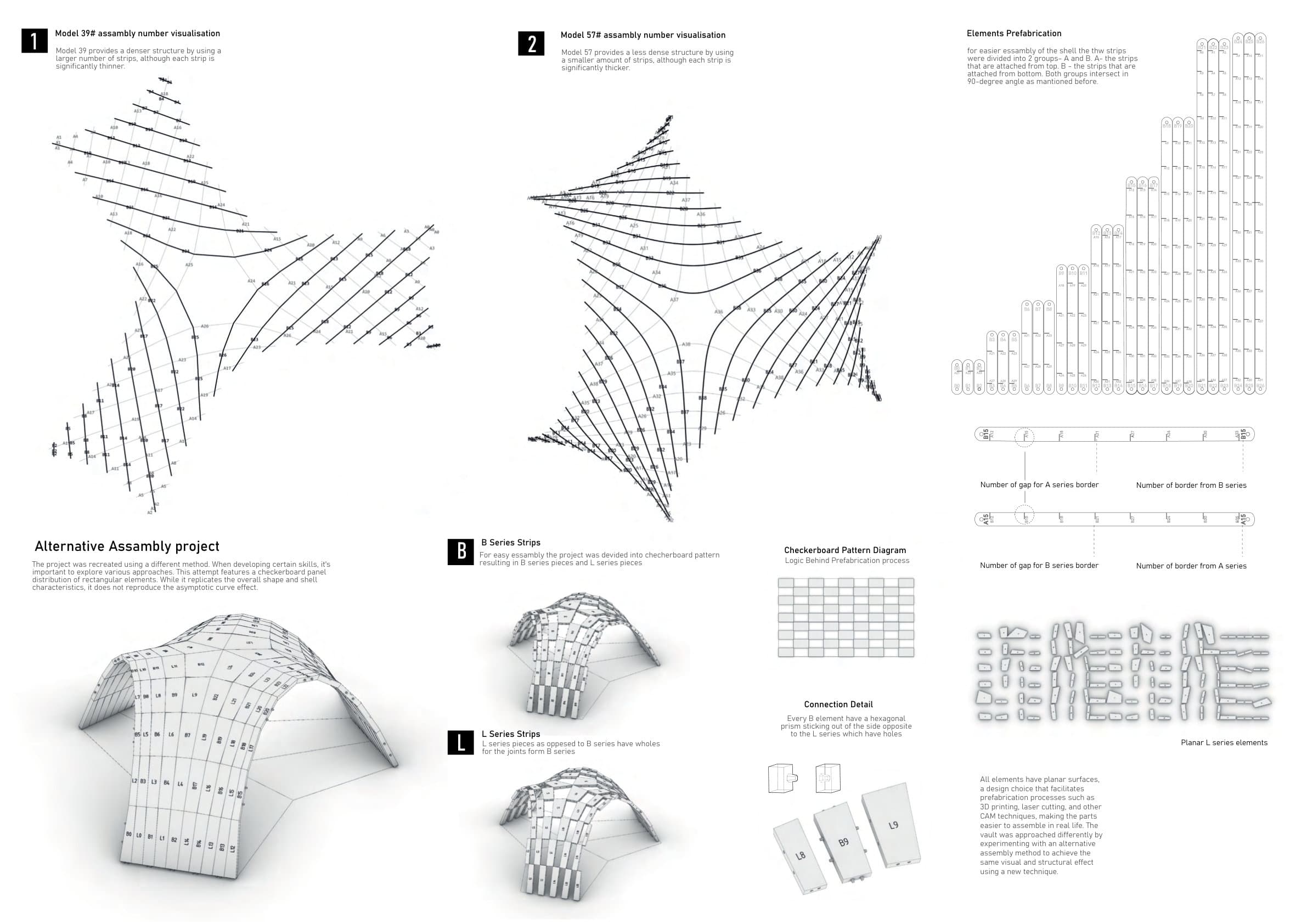
Two assembly strategies for the same shell. Model 39 uses a denser grid: more strips, each significantly thinner. Model 57 uses fewer, significantly thicker strips. Both were built, numbered and compared. The denser model follows the geometry more smoothly, the sparser one is faster to fabricate and assemble.
Alternative checkerboard assembly
To sharpen the skill set, the same geometry was rebuilt with a checkerboard pattern of rectangular B- and L-series pieces. B-series carry a hexagonal prism sticking out of the side; L-series have matching holes on the opposite side. All elements are planar on one side to suit 3D printing, laser cutting and other CAM techniques. Same shell behaviour, different assembly logic, but without the asymptotic-curve effect.